If you are considering a VA refinance, you may have seen recent reports about a possible increase in VA home-loan fees. Before you make a decision, it is important to separate the proposal from the current rules.
H.R. 9237, the Take Care of America’s Veterans Act, has not passed the House and is not law. On July 16, 2026, a motion to recommit failed by a 210–211 vote, and further consideration was postponed. The proposed fee changes could still be amended, removed, or fail to become law.
Current VA rules apply today.
What the proposal would change
The proposed changes appear in Section 104(b) of H.R. 9237. That section carries forward home-loan fee provisions originally developed in the standalone H.R. 6047, the Sharri Briley and Eric Edmundson Veterans Benefits Expansion Act, before those provisions were folded into the broader veterans package.
For certain non-exempt borrowers, Section 104(b) would change two fees:
- IRRRL funding fee: The fee for an Interest Rate Reduction Refinance Loan, also called a VA Streamline Refinance, would increase from 0.50% to 1.42%.
- VA loan assumption fee: The fee for assuming an existing VA-backed loan would increase from 0.50% to 1%.
The proposal does not create a new IRRRL fee based on whether a veteran is using the VA home-loan benefit for a second or third time.
An IRRRL is generally used to help an existing VA borrower obtain a lower interest rate or reduce a monthly payment. The proposed increase could make that calculation more difficult for some borrowers.

What the proposed increase could mean in dollars
The following examples come from the reported proposal and are illustrations only. Actual costs would depend on the outstanding loan balance, the borrower’s eligibility, and the final law, if any.
Example 1: A $400,000 IRRRL
An Air Force veteran refinancing a $400,000 VA-backed mortgage solely to obtain a lower rate and payment would face these potential fees:
- Under the current 0.50% rate: $2,000
- Under the proposed 1.42% rate: $5,680
- Potential difference: $3,680
The proposed fee would not automatically make every refinance a bad choice. However, it would increase the savings needed to make the transaction worthwhile.
Example 2: Multiple VA-backed properties
A veteran with approximately $1.15 million in combined VA-backed mortgage debt across four properties could see a larger cumulative impact.
The proposed increase is 0.92 percentage points. If all four loans were refinanced and each were subject to the proposed fee, the additional funding fees could total approximately $10,580.
The actual amount would depend on each property’s outstanding balance, the borrower’s exemption status, and the terms in effect when the loans are refinanced.
The fee can usually be financed: but financing has a cost
Borrowers who must pay the VA funding fee can usually choose between two approaches:
- Pay the fee at closing.
- Finance the fee into the new loan balance.
Financing avoids a larger upfront payment. It also increases the loan balance. The borrower then pays interest on the financed fee over time.
This is why it is important to compare more than the advertised interest rate. A lower rate and lower monthly payment may still result in limited savings after the funding fee, lender charges, discount points, and other closing costs are included.
Who may be exempt from the funding fee?
VA exempts certain borrowers from the funding fee. Under current VA guidance, exemptions include certain borrowers who:
- Receive VA compensation for a service-connected disability.
- Are eligible to receive VA compensation for a service-connected disability but receive retirement or active-duty pay instead.
- Have a qualifying pre-discharge disability rating or memorandum rating before closing.
- Receive Dependency and Indemnity Compensation as an eligible surviving spouse.
- Are active-duty service members who have received a Purple Heart and provide the required evidence.
Active-duty status alone does not qualify a borrower for a funding-fee exemption.
If you believe you qualify, ask your lender to verify your status with the VA before you compare loan options. An exemption could significantly change the cost of a refinance.
You can review current requirements on the VA funding fee and closing costs page.
VA refinance activity has increased
The potential impact matters because many veterans use IRRRLs when market rates become more favorable.
The VA reported 119,457 IRRRLs in 2025, compared with 50,825 in 2024. That was a 135% increase.
However, VA public loan-volume reports do not identify how many of those borrowers paid the funding fee or how many were active-duty service members. That makes it difficult to determine exactly how many borrowers would be affected by the proposed increase.
Why lenders and industry groups are concerned
Marcia Black, a VA loan officer with M&T Bank, expressed concern that higher fees could discourage veterans from refinancing when rates fall:
“Higher fees deter veterans from refinancing when market interest rates drop, trapping them in higher-rate loans.”
Black also said that targeting refinances could disproportionately affect active-duty military members and veterans who are trying to lower monthly payments during high-cost economic cycles.
The Mortgage Bankers Association said it could not support H.R. 6047 as drafted because of the proposed funding-fee increases. The association urged Congress to remove or substantially modify those provisions.
The budget context is also important. The fee provisions are intended to serve as budgetary offsets for a broader package containing more than 60 veterans’ bills.
In its March 2026 estimate of standalone H.R. 6047, the Congressional Budget Office projected that the home-loan fee provisions would reduce net direct spending by approximately $4 billion from 2026 through 2036 by lowering the subsidy cost of VA loan guarantees. CBO estimated that the overall H.R. 6047 package would reduce net direct spending by approximately $42 million over that period.
That explains the budget purpose of the provisions. It does not change the fact that the proposed fees could increase costs for affected borrowers.
A separate benefit already in effect
Beginning with the 2026 tax year, the VA funding fee is deductible for eligible borrowers who itemize deductions on Schedule A. This is separate from H.R. 9237 and does not prevent the proposed fee increase.
Tax rules can be specific to your situation. Speak with a qualified tax professional before relying on a potential deduction.
Practical steps before refinancing
Whether you refinance under current rules or after a future law change, use a careful process.
1. Request a net tangible benefit worksheet
Ask the lender to show how the refinance benefits you. The worksheet should identify the rate change, payment change, fees, loan balance, and expected savings.
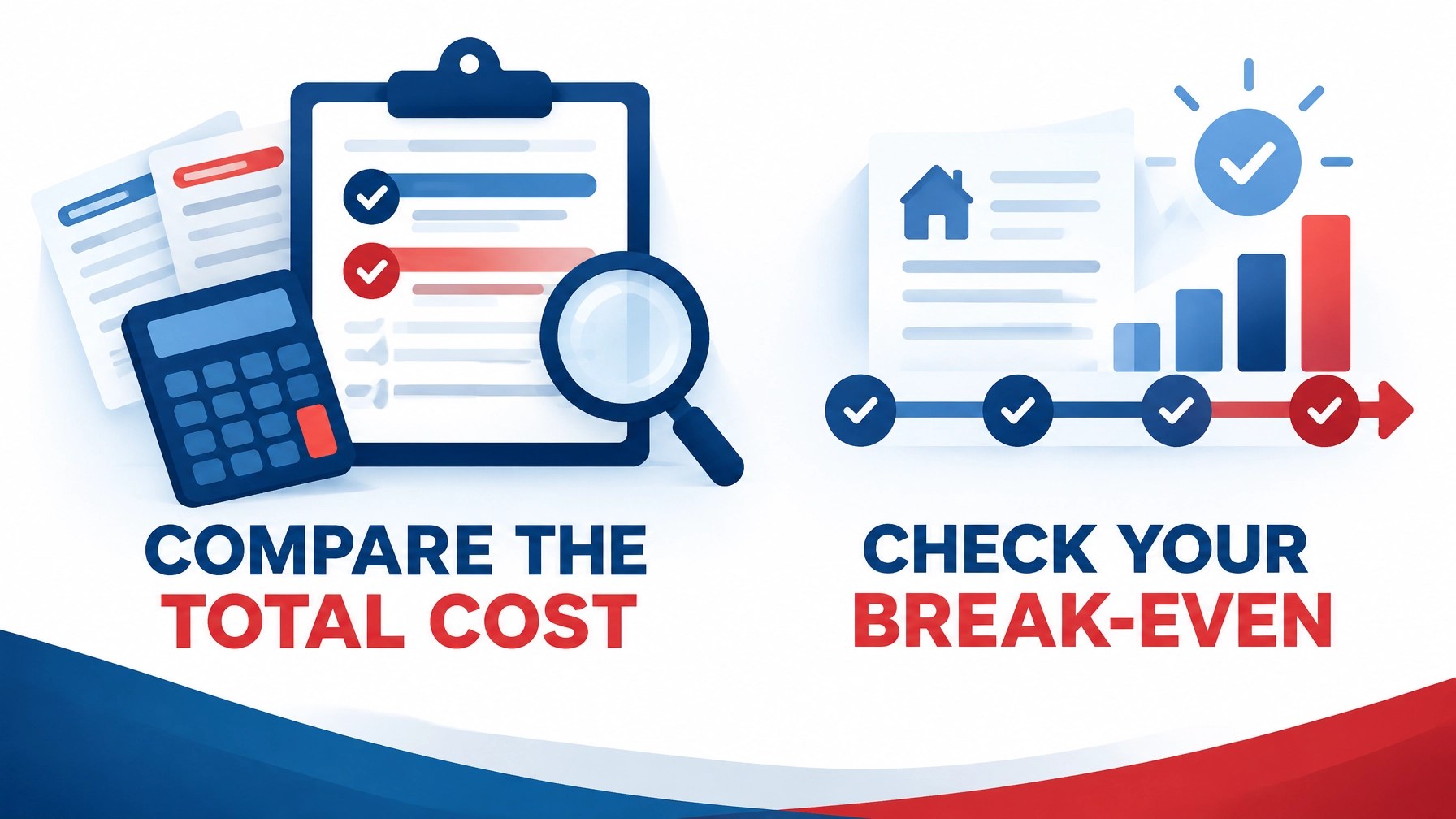
2. Compare actual costs with actual savings
Do not focus only on the new interest rate. Review:
- The funding fee.
- Lender fees.
- Discount points.
- Closing costs.
- The new loan balance.
- The total interest over the life of the loan.
3. Confirm the break-even timeline
Calculate how many months of lower payments it would take to recover the refinance costs.
For example, if the refinance costs several thousand dollars and lowers the payment by a few hundred dollars per month, you need to know how long it takes to reach the break-even point. If you expect to move, sell, or refinance again before that point, the transaction may not provide the expected benefit.
4. Verify your exemption status
Ask whether you qualify for a funding-fee exemption. Do not assume that active-duty service automatically qualifies you.
5. Ask how the fee will be paid
Confirm whether the funding fee will be paid at closing or financed into the loan. If it is financed, ask how much additional interest you may pay over time.
6. Get more than one quote
Loan terms and lender fees can vary. Request quotes from multiple lenders and compare the full Loan Estimates, not just the advertised rate.
7. Watch for loan churning
Loan churning occurs when a lender repeatedly refinances a VA loan to generate fees without providing a meaningful benefit to the borrower.
The proposed fee increase could make that math worse. Ask a direct question:
Does this refinance actually help me after all costs are included?
One possible source of transaction-cost assistance
Operation T.A.G. is a 501(c)(3) nonprofit project of the High Desert Community Foundation. Its Hometown Hero Credit is a partnership between Operation T.A.G. and PRMG, one of the nation's top VA lenders. Operation T.A.G. administers the program, and PRMG is the lending partner that originates and underwrites the VA loan for eligible borrowers.
PRMG is ranked among the nation's leading VA lenders in published industry rankings, including a No. 14 national ranking for VA loans in the 2026 Scotsman Guide, along with top-5 wholesale and top-15 FHA rankings. These are industry rankings, not a guarantee of service or outcome.
Subject to program rules, the 2% credit up to $21,000 may help eligible veterans, active-duty service members, reservists, and Gold Star surviving spouses with a home purchase or refinance. It requires no repayment when used according to program terms.
The 2% credit up to $21,000 may be applied to eligible closing fees, buying down the interest rate, real estate agent fees, and, in some cases, paying down debt to help with VA loan qualification.
It cannot be used for a down payment or for non-loan purposes. The credit is calculated on the loan amount, not the sales price. VA loans generally do not require a down payment.
Because a nonprofit administers the credit and a top-tier VA lending partner handles the loan, military families get transparency about the money and experienced VA lending under one roof.
The Hometown Hero Credit is a nonprofit program of Operation T.A.G., and PRMG is the mortgage lending partner. Final loan approval, terms, rates, and eligibility are determined by PRMG and applicable program and lender requirements. The credit does not guarantee loan approval.
The Hometown Hero Credit does not offset or cancel the proposed fee increase, and eligibility is not guaranteed. It is one potential way eligible military families may lower transaction costs while evaluating their options.
Learn more at OperationTAG.org and HometownHeroCredit.com.
Operation T.A.G. believes gratitude should be tangible, not just a slogan. The best next step is to compare the numbers, confirm the rules, and make a decision based on your own timeline and financial goals.
Sources and further reading
- Military Times: Proposed VA loan fee hike could make refinancing more expensive for some borrowers
- H.R. 9237: Take Care of America’s Veterans Act
- H.R. 6047: Sharri Briley and Eric Edmundson Veterans Benefits Expansion Act
- VA funding fee and loan closing costs
- Congressional Budget Office estimate for H.R. 6047
Brett Stacy
National Director & Founder of the Hometown Hero Credit, a program of Operation T.A.G. (Tangible Act of Gratitude), and 501(c)(3) non-profit project of HDCF

760-456-8748 : 24-hour Information Line
OperationTAG.org
HometownHeroCredit.com
Free Mission Homeownership PDF E-Book
A separate educational homeownership resource for military families and veterans.

Educational information only. This article is not legal, financial, or tax advice. H.R. 9237 has not been enacted, and its provisions could change or fail. Current VA rules apply today. Verify details with the VA, your lender, and a qualified professional.
Leave a Reply