If you have served, you may assume your VA home loan benefit was used once and is now gone. That is a common misunderstanding.
The VA home loan is a lifetime benefit, not a one-time benefit. Life changes. You may receive PCS orders, accept a job in another city, or need a larger home for your family. In many cases, you can keep your current home and use remaining entitlement to buy another home you intend to occupy.
Your Certificate of Eligibility, or COE, is the document that helps answer the question: “How much VA loan entitlement do I still have?”
What the COE actually is
A COE shows your lender that you qualify for the VA home loan benefit based on your service history and duty status.
It is not:
- A loan approval
- A pre-approval
- A promise that you will receive financing
You must still meet VA and lender requirements for credit, income, debts, assets, and occupancy. Start with the VA eligibility page to review the requirements that apply to your service.
How to get your COE: Three ways
You can request a COE in three ways:
- Online through VA.gov: This is usually the fastest option. Request your COE online.
- Through your lender: A VA-approved lender may submit an online application through the VA system.
- By mail: Complete VA Form 26-1880 and mail it to the address listed on the form. This is generally the slowest option.
Have your DD214, statement of service, National Guard or Reserve records, or surviving-spouse documentation available, depending on your situation.
The two numbers nobody explains
1. Basic entitlement
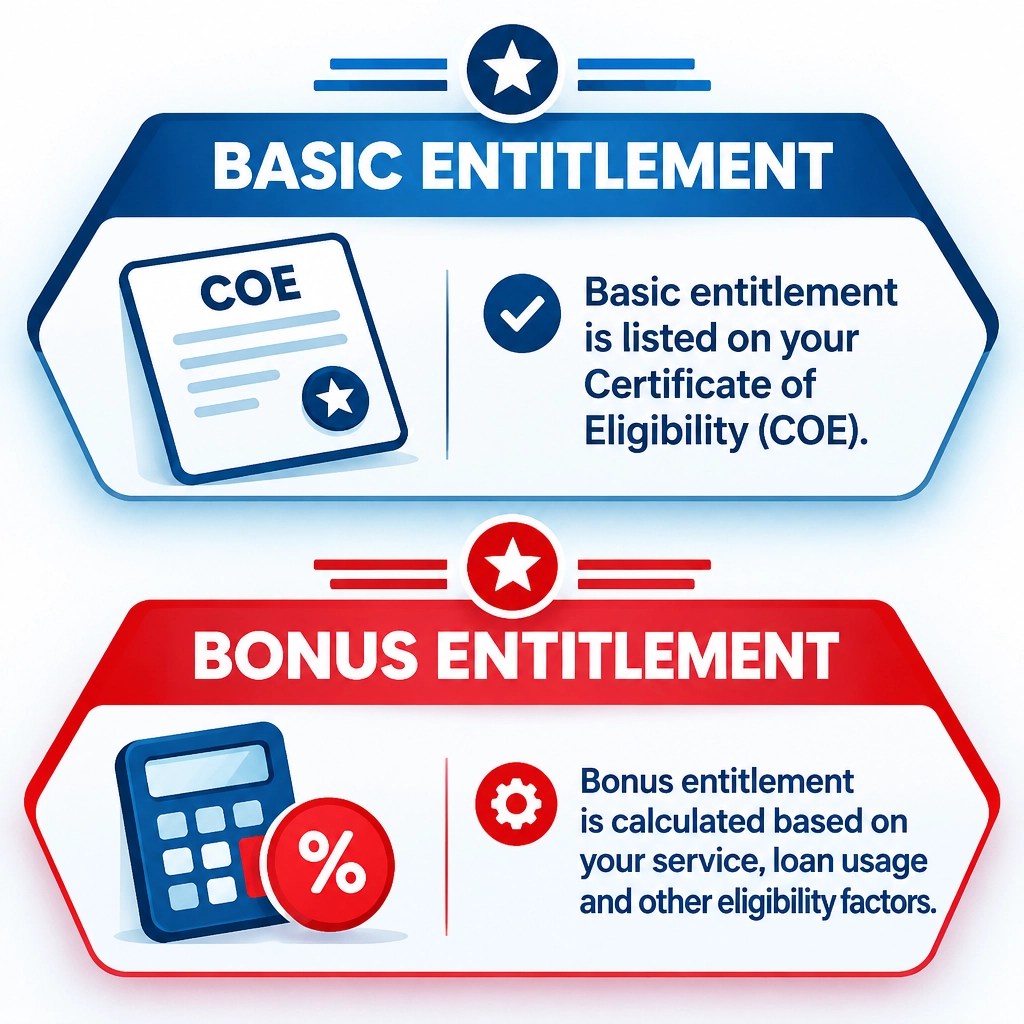
Basic entitlement is also called first-tier or Tier 1 entitlement. It is the dollar amount shown on your COE.
The classic figure is $36,000. That does not mean you can borrow only $36,000.
Instead, $36,000 is the maximum amount the VA will pay your lender if you default on a loan of $144,000 or less. For loans above $144,000, the VA generally guarantees up to 25% of the loan amount.
If your COE shows $36,000 in basic entitlement, you have full entitlement. You do not have a VA loan limit tied to the county limit, as long as:
- You can afford the loan.
- Your lender approves the application.
- The appraisal supports the purchase price.
2. Bonus entitlement
Bonus entitlement is also called second-tier or Tier 2 entitlement. It is not listed directly on your COE. You calculate it using your county loan limit and the entitlement already used.
If your COE shows $0 basic entitlement, that does not necessarily mean you are out of options. It means you have no remaining basic entitlement, but you may still have bonus entitlement available for a loan above $144,000.
How to calculate your remaining bonus entitlement
Use these four steps:
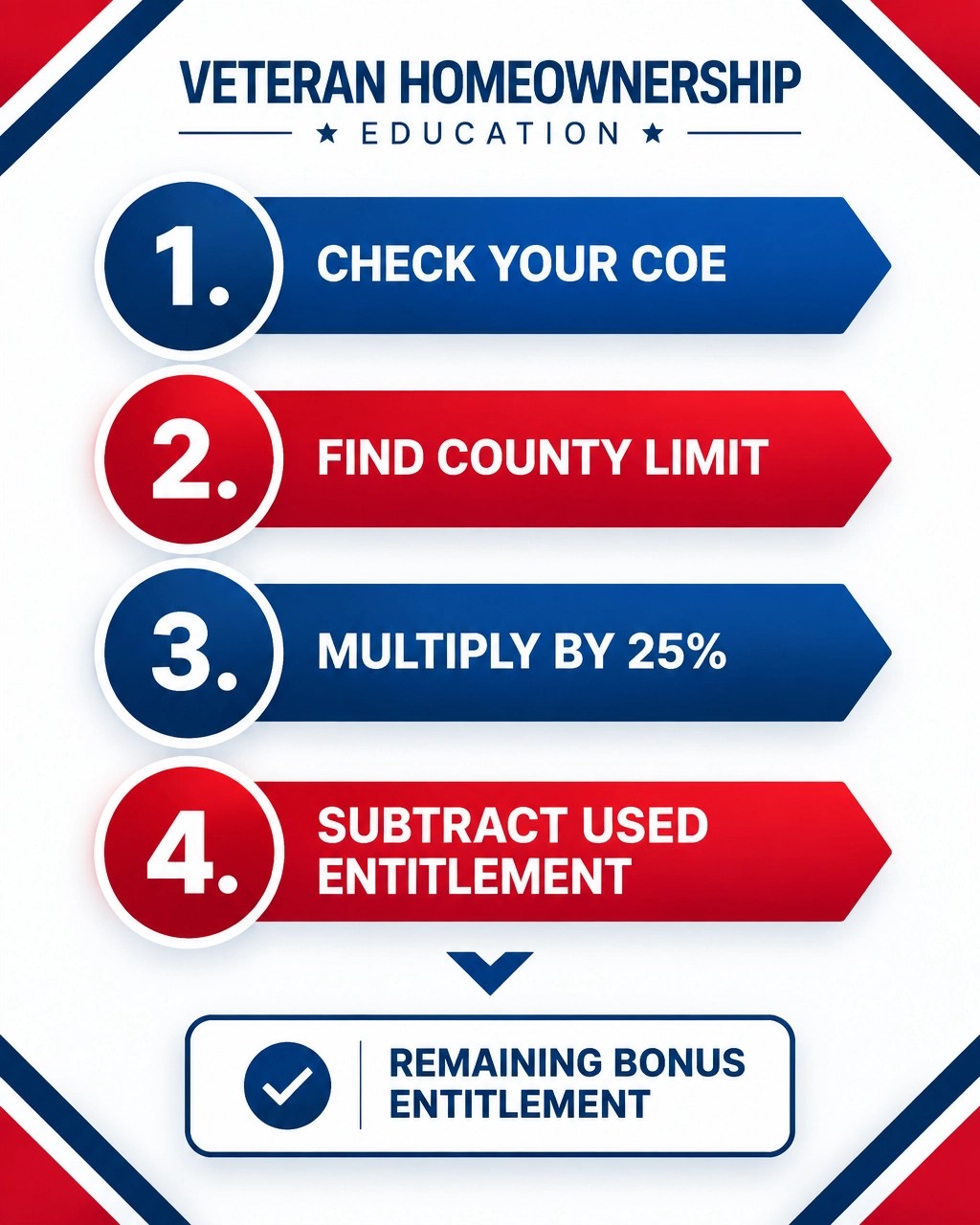
- Check your COE. In the table called “Prior Loans charged to entitlement,” find the amount in the Entitlement Charged column.
- Find the county loan limit for the property you want to buy. VA loan limits match the FHFA conforming loan limits. Use the One-Unit Limit, even if the property has more than one unit.
- Multiply the county loan limit by 25%.
- Subtract the entitlement already used from that result. The difference is your remaining bonus entitlement.
Then multiply your remaining bonus entitlement by 4. This estimates the maximum loan amount most lenders would lend without a down payment.
Example A: VA’s full-entitlement illustration
The following is the VA’s hypothetical example:
John bought his first home in Tampa, Florida, in 2018 with a $300,000 VA-guaranteed loan. He lived there and satisfied the two-year occupancy requirement. This year, he accepted a job in Orlando and wants to keep the Tampa home while buying a $500,000 home in Orlando.
John’s COE shows $75,000 in the Entitlement Charged column. The Orlando county loan limit is $832,750.
- $832,750 x 25% = $208,187.50
- $208,187.50 – $75,000 = $133,187.50 remaining entitlement
- $133,187.50 x 4 = $532,750
Because his remaining entitlement supports a loan up to $532,750, John may buy the $500,000 home with no down payment. The home must appraise at value, he must intend to occupy it, and he must meet his lender’s underwriting requirements.
John now has two active VA loans. Read the full VA News explanation.
Example B: VA’s bonus-entitlement illustration
In the VA’s second hypothetical example, a veteran’s COE shows $50,000 already used and no remaining basic entitlement. The county loan limit is $900,000.
- $900,000 x 25% = $225,000
- $225,000 – $50,000 = $175,000 remaining bonus entitlement
- $175,000 x 4 = $700,000
The $700,000 figure is the maximum amount most lenders would lend without a down payment in this example. Your actual result depends on your county, existing loans, income, debts, credit, and lender requirements.
What full entitlement does not mean
Full entitlement does not mean your lender must approve any loan amount.
Lenders determine what you can afford by reviewing your:
- Credit history
- Income
- Debts
- Assets
The VA does not require a minimum credit score, but individual lenders may. Contact more than one lender so you can compare requirements, rates, fees, and service.
The appraisal also matters. The maximum VA loan on an individual property is the purchase price or appraised value, whichever is lower.
For example, if you are preapproved for $450,000, sign a $400,000 contract, and the appraisal is $375,000, the loan is capped at $375,000.
When you might need a down payment
Your lender may require a down payment if your remaining bonus entitlement is not enough to cover a 25% VA guaranty for the loan amount you want.
Most lenders require your entitlement, down payment, or a combination of both to cover at least 25% of the total loan amount.
If you are able and willing to make a down payment, you may be able to borrow more than the county loan limit with a VA-backed loan. The lender must still approve the loan.
How to restore entitlement you already used
You may be able to restore entitlement when at least one of these conditions applies:
- You sold the home purchased with the prior loan and paid that loan in full.
- A qualified veteran-transferee assumes your loan and substitutes their entitlement for the amount you used.
- You repaid the prior loan in full but have not sold the home. This option can generally be used only once.
You can request restoration online, ask your lender to submit the request, or file VA Form 26-1880.
Even if you do not meet a restoration requirement, you may still have remaining entitlement to buy or refinance another home.
Who else may qualify for a COE?
Eligibility depends on service dates and individual records. In general:
- Service members: At least 90 continuous days of service.
- Veterans: Requirements vary by service period. For the Gulf War period to the present, qualifying paths generally include 24 continuous months, the full period of at least 90 days called to active duty, qualifying exceptions, or a service-connected disability discharge.
- National Guard members: Qualifying paths may include 90 days of non-training Title 10 service, 90 days including at least 30 consecutive days under qualifying activation, or six creditable years with continuing service, honorable discharge, or retirement status.
- Reserve members: Qualifying paths may include 90 days of non-training active duty or six creditable years in the Selected Reserve with continuing service, honorable discharge, or retirement status.
- Surviving spouses: Eligibility may apply to spouses receiving certain VA Dependency and Indemnity Compensation, or spouses of active-duty service members who are missing in action or prisoners of war.
Qualifying discharge exceptions may include hardship, convenience of the government, early out, involuntary reduction in force, certain medical conditions, or a service-connected disability.
If you received an other-than-honorable, bad conduct, or dishonorable discharge, you may still apply. The VA can review your records, and you may pursue a discharge upgrade or a VA Character of Discharge review.
Four things to check before using your benefit again
- Know your remaining entitlement. An existing VA loan does not automatically disqualify you.
- Understand occupancy. You generally must certify that you intend to live in the home. A VA loan cannot be used for a vacation home or investment property. Misrepresenting occupancy intent may result in legal action.
- Understand the funding fee. Using the benefit again may result in a higher funding fee unless you qualify for an exemption, such as receiving service-connected disability compensation. Beginning with the 2026 tax year, the funding fee may be deductible for eligible borrowers who itemize. Verify tax treatment with a qualified tax professional.
- Budget for multiple mortgages. Include payments, taxes, insurance, maintenance, and other ownership costs.
How the Hometown Hero Credit may help
The Hometown Hero Credit program is a partnership between Operation T.A.G. and PRMG, one of the nation’s top VA lenders. Operation T.A.G. is a 501(c)(3) nonprofit project of the High Desert Community Foundation and administers the program. PRMG is the lending partner that originates and underwrites the VA loan.
PRMG’s published industry rankings include No. 14 nationally for VA loans in the 2026 Scotsman Guide. Rankings are industry measures, not a guarantee of an outcome.
For eligible veterans, active-duty service members, reservists, and Gold Star surviving spouses, the Hometown Hero Credit nonprofit program provides a 2% credit up to $21,000 with no repayment required when used according to program terms. The credit may be applied to eligible closing fees, buying down the interest rate, real estate agent fees, and, in some cases, paying down debt to help with VA loan qualification.
It cannot be used for a down payment or non-loan purposes. The 2% credit up to $21,000 is calculated on the loan amount, not the sales price. Final loan approval, rates, terms, and eligibility are determined by PRMG and applicable program and lender requirements. The credit does not guarantee loan approval.
Reading your COE tells you what you are entitled to. The Hometown Hero Credit nonprofit program may help with what it costs to use that benefit.
Where to get help
Call the VA Loan Guaranty Service at 877-827-3702 or TTY 711, Monday through Friday, 8 a.m. to 6 p.m. Eastern Time. You can also use the VA Loan Guaranty support portal.
Review the VA’s pages for eligibility and loan limits, then compare your options with a VA-approved lender.
Thank you for reading and for taking the time to understand the benefit you earned.
Brett Stacy
National Director & Founder of the Hometown Hero Credit, a program of Operation T.A.G. (Tangible Act of Gratitude), and 501(c)(3) non-profit project of HDCF

Operation T.A.G. contact information
- Phone: 760-456-8748 – 24-hour Information Line
- Website: OperationTAG.org
- Website: HometownHeroCredit.com
Free Mission Homeownership PDF E-Book
A separate educational homeownership resource:

Disclaimer: This article is for educational information only. It is not legal, financial, or tax advice. VA eligibility rules, loan limits, entitlement amounts, funding-fee rules, and lender requirements can change. Verify your COE and options with the VA and a VA-approved lender. Operation T.A.G. is not affiliated with or endorsed by the Department of Veterans Affairs.
Leave a Reply