If you are a veteran seeking help with a VA disability claim, one question can protect your money and personal information:
“Are you VA-accredited?”
That question matters because New York and Illinois officials are investigating Trajector Medical, a Florida company accused of charging veterans as much as $20,000 for assistance with VA disability claims.
This remains an ongoing investigation. No court has found Trajector liable. The allegations described here are unproven.
Trajector has denied the allegations. Spokesman Steve Zenofsky told NPR, “We stand behind how we operate, and we're focused on the veterans we serve.” Trajector bankruptcy attorney Edward Peterson said, “The letter speaks for itself. We deny the allegations in the letter.”
Trajector states that its fees are for independent medical evidence only. The company says those fees are payable only if a veteran’s benefits increase because of that evidence. Trajector also says it does not file initial claims.
What the states are investigating
According to a September 8 letter filed in the U.S. Bankruptcy Court for the Middle District of Florida, the attorneys general of New York and Illinois said they have ongoing investigations and “intend to commence legal action” against Trajector for what they describe as “fraudulent, illegal and deceptive business practices.”
The state officials told the court they expect their investigations to show that money held in the bankruptcy process was collected through “illegality and fraud.” Their position is that this money should not be treated as property of the bankruptcy estate. In plain terms, they argue that it is not Trajector’s money.
The states are also investigating whether Trajector misused personal information collected through automated calling systems.
What NPR reported about “CallBot”
NPR reported in December 2025 that Trajector used a robo-dialer system called “CallBot.” According to NPR’s reporting, the system dialed into a VA benefits phone hotline and entered a veteran’s Social Security number to monitor changes in VA benefit payments.
When CallBot detected an increase, Trajector allegedly sent a bill. NPR reported that this could happen even when the company had not helped the veteran obtain the increase.
NPR and The War Horse also reported that Trajector was not the only claims company using this type of technology.
This is an important distinction for readers: a company asking for your Social Security number so it can check your VA benefit status is not the same as a VA-accredited representative helping you with your claim.
The bankruptcy and pending lawsuits
Trajector Medical and 21 affiliated companies filed for Chapter 11 bankruptcy. Court filings indicate that the affiliated companies employ more than 450 people and hold approximately $405 million in assets. Their combined income in 2025 was nearly $280 million.
According to court filings, the company filed for bankruptcy five days before it was expected to default on almost $63 million owed to Deutsche Bank.
Chapter 11 allows a company to continue operating while reorganizing its finances. It also froze the civil lawsuits filed against Trajector.
Two lawsuits filed separately in Florida earlier this year allege deceptive and unfair trade practices, including charging veterans for preparing initial VA disability claims. Trajector’s contracts acknowledge that the company is not VA-accredited.
NPR also reported financial and property disclosures from the bankruptcy case and public records. CEO Jim Hill has a base salary of $600,000 per year, with the possibility of performance-based bonuses of $600,000 each quarter. Co-founder Gina Uribe earns $197,000 annually and does not receive bonuses.
Hill and his wife purchased a $5.75 million oceanfront home in St. Augustine, Florida, in September 2025. Trajector lists the home as its “principal offices” in bankruptcy filings, while its corporate headquarters is in Gainesville. The home is not listed as a company asset. When asked about the timing, Zenofsky told NPR, “the two are not related in any way.”
These reported facts do not establish liability or wrongdoing.
Why accreditation matters
Federal law requires anyone who prepares, presents, or prosecutes a VA claim to be accredited by the VA.
Accredited representatives generally cannot charge veterans for help with an initial disability claim. Fees may be permitted in limited circumstances during the appeal process, after VA has issued an initial decision.
In 2006, Congress eliminated federal criminal penalties for charging veterans for help with initial claims but left the underlying law intact. The ban remains on the books, but enforcement became more difficult.
The VA has issued cease-and-desist letters to Trajector regarding its unaccredited status and fee practices. The VA currently lacks direct authority to penalize unaccredited entities.
The legal landscape also varies by state. California passed a bill in February that will impose penalties on unaccredited claims companies beginning next year. That same month, a federal judge struck down Louisiana’s 2024 law that had allowed these companies to operate with fees capped at $12,500.
Trajector has said it suspended services in 23 states where local laws prevent, severely limit, or create undue risks for continued operations. The company also reported that revenue during the first half of 2026 declined approximately 60 percent compared with the prior year, primarily because of legal and regulatory changes.
Congress remains divided over whether to restore civil penalties for unaccredited claims companies or create a regulated industry with fee caps. New bills were introduced as recently as June 2026.
The one question that protects you
Before signing a contract or sharing records, ask:
“Are you VA-accredited?”
Then verify the answer yourself using the VA Office of General Counsel accreditation database.
Do not rely only on a company’s website, advertisement, or sales representative. The VA database allows you to search accredited attorneys, claims agents, Veterans Service Organization representatives, and recognized VSOs.
Warning signs to watch for
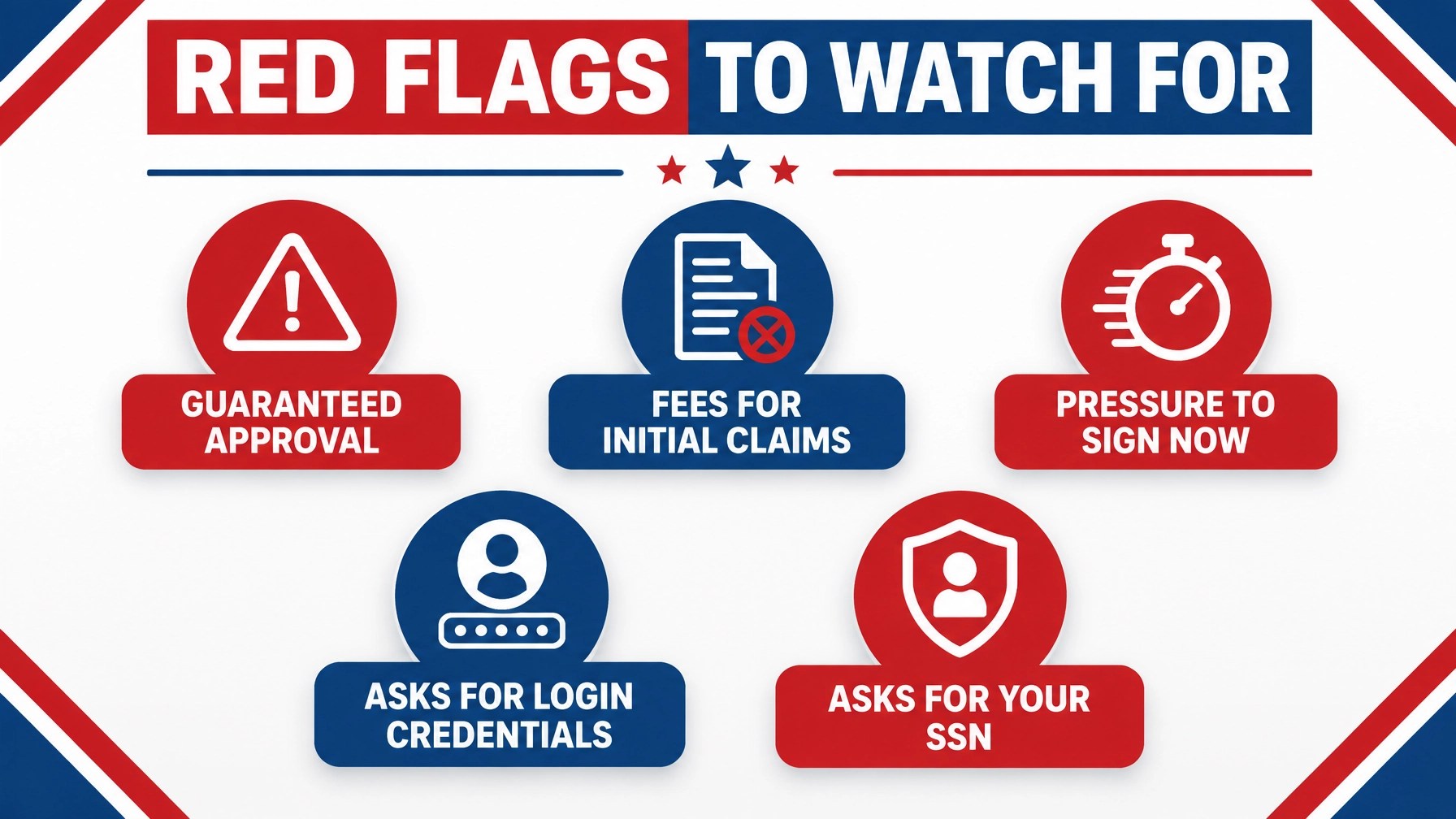
Use caution if anyone:
- Guarantees approval or promises a specific benefit amount
- Charges for help with an initial claim
- Pressures you to sign or act immediately
- Requests your VA.gov or myHealtheVet login credentials
- Offers to check your benefit status using your Social Security number
- Provides a contract that acknowledges the company is not VA-accredited
You can ask questions, compare options, and take time to review a contract. You do not have to decide immediately.
Free and accountable options
Free help is available through VA-accredited organizations and representatives, including:
- Veterans of Foreign Wars
- The American Legion
- Disabled American Veterans
- AMVETS
- County and state veterans service offices
- VA-accredited attorneys and claims agents
- The VA at 1-800-827-1000
Accredited help is not only free for an initial claim. It is also accountable. Accredited representatives are subject to VA oversight and can lose accreditation for misconduct.
NPR also spoke with veterans who said they were pleased with Trajector’s assistance in increasing their benefits. That perspective belongs in this discussion. Veterans can have different experiences with the same company.
Dustin Ingram, a former Army Ranger who served two tours in Afghanistan, told NPR that Trajector charged him $4,500. He said he believed the company took advantage of him and accessed VA information to determine whether he had received a claim decision. He refused to pay and described the lawsuits and investigations as “vindicating.”
Ingram also said, “If we create a vacuum, they will fill it.” He argued that the military should do more to connect service members with benefits during transition. In his words, “It should be very simple and very easy to receive benefits.”
If you already paid a claims company
Take these steps:
- Keep your contracts, invoices, emails, and payment records.
- Check whether the company and representative are VA-accredited.
- Contact your state attorney general’s office or the attorney general in the state where the company operates.
- Report concerns to the VA at 1-800-827-1000 or VSAFE at 1-833-38V-SAFE.
- Consider speaking with a consumer protection attorney.
- If the company is in bankruptcy, understand that recovery may be limited.
Bruce Markell, a former bankruptcy judge and professor at Northwestern University Pritzker School of Law, told NPR, “In a corporate bankruptcy, there is no exception for fraud.” He said veterans who believe they are owed money may be treated like other creditors in the bankruptcy process.
Attorney Jennifer Byrd, who is bringing one of the lawsuits, called the attorneys general becoming involved “a huge development.” She also noted that the bankruptcy court cannot stop the states from continuing their investigations.
How Operation T.A.G. approaches veteran support
Operation T.A.G. does not charge veterans for help they are entitled to receive. We do not buy or sell veteran data. We do not run targeted, unsolicited lead-generation campaigns. We do not ask for VA login credentials.
There's a difference between SERVING military families…and just MARKETING to them.
The Hometown Hero Credit is a non-profit homebuying program, not a VA benefits-claims service and not emergency assistance. It is a partnership between Operation T.A.G. and PRMG, one of the nation’s top VA lenders. Operation T.A.G. is the 501(c)(3) nonprofit project of the High Desert Community Foundation and administers the program. PRMG is the lending partner that originates and underwrites the VA loan.
The program provides a 2% credit up to $21,000 to help eligible military families buy or refinance a home. The credit may be applied to closing fees, buying down the interest rate, paying real estate agent fees, or, in some cases, paying down debt to help with VA loan qualification. It cannot be used for a down payment or for non-loan purposes. The 2% credit is calculated on the loan amount, not the sales price. VA loans generally do not require a down payment.
PRMG is ranked No. 14 nationally among Top VA Lenders in the 2026 Scotsman Guide rankings. That is an industry ranking, not a guarantee of an outcome. Final loan approval, terms, rates, and eligibility are determined by PRMG and applicable program and lender requirements.
Final reminder
Before you share documents or sign an agreement for VA claim assistance, verify accreditation yourself. Use free, accountable resources whenever possible. Keep records of every transaction and seek qualified legal advice if you believe you were charged improperly.
This article provides educational information only. It is not legal or financial advice. All allegations described are unproven and are the subject of ongoing investigations. No court has found Trajector Medical liable. Trajector denies the allegations. Consult a qualified attorney about your own situation. Reporting summarized here is attributed to NPR, GPB, and Military.com.
Operation T.A.G. is a 501(c)(3) nonprofit project of the High Desert Community Foundation. Operation T.A.G. is not affiliated with or endorsed by the Department of Veterans Affairs.
Brett Stacy
National Director & Founder of the Hometown Hero Credit, a program of Operation T.A.G. (Tangible Act of Gratitude), and 501(c)(3) non-profit project of HDCF.
Websites: www.OperationTAG.org and www.HometownHeroCredit.com
Phone: 760-456-8748 (24-hour Information Line)

Free Mission Homeownership Educational Resource
Scan the QR code to access the free Mission Homeownership PDF e-book.

Leave a Reply