Welcome, and thank you for taking a few minutes to review this important update. If your family uses, or may qualify for, Chapter 35 Survivors’ and Dependents’ Educational Assistance, also called DEA, one part of the benefit changed on August 1, 2026.
The most important message is simple:
Chapter 35 is not ending.
However, Chapter 35 DEA no longer covers certain secondary-education programs when the program begins on or after August 1, 2026. That change may affect some military and veteran families who were using the benefit for high-school coursework, GED-level training, tutoring, or academic remediation.
Here is what families need to know and what to do next.
What Is Chapter 35 DEA?
Chapter 35 is a VA education benefit for certain eligible spouses and children of veterans or service members.
A family member may qualify when the veteran or service member:
- Has a permanent and total service-connected disability.
- Died as a result of a service-connected condition.
- Died while serving on active duty or in the line of duty.
- Is missing in action or was captured in the line of duty.
- Was forcibly detained or interned by a foreign entity while serving.
- Meets certain other VA eligibility requirements.
These are general examples. Not every family member of a veteran or service member automatically qualifies.
Chapter 35 generally provides a monthly payment directly to the eligible student. The payment can help cover education-related costs or expenses while the student attends an approved program or completes qualifying job training.
Payment rates vary based on the type of education or training and the student’s enrollment status. The student must also meet applicable eligibility, entitlement, timing, enrollment, and program-approval requirements.
The VA makes the final determination.
What Changed on August 1, 2026?
The change is based on Public Law 117-328.
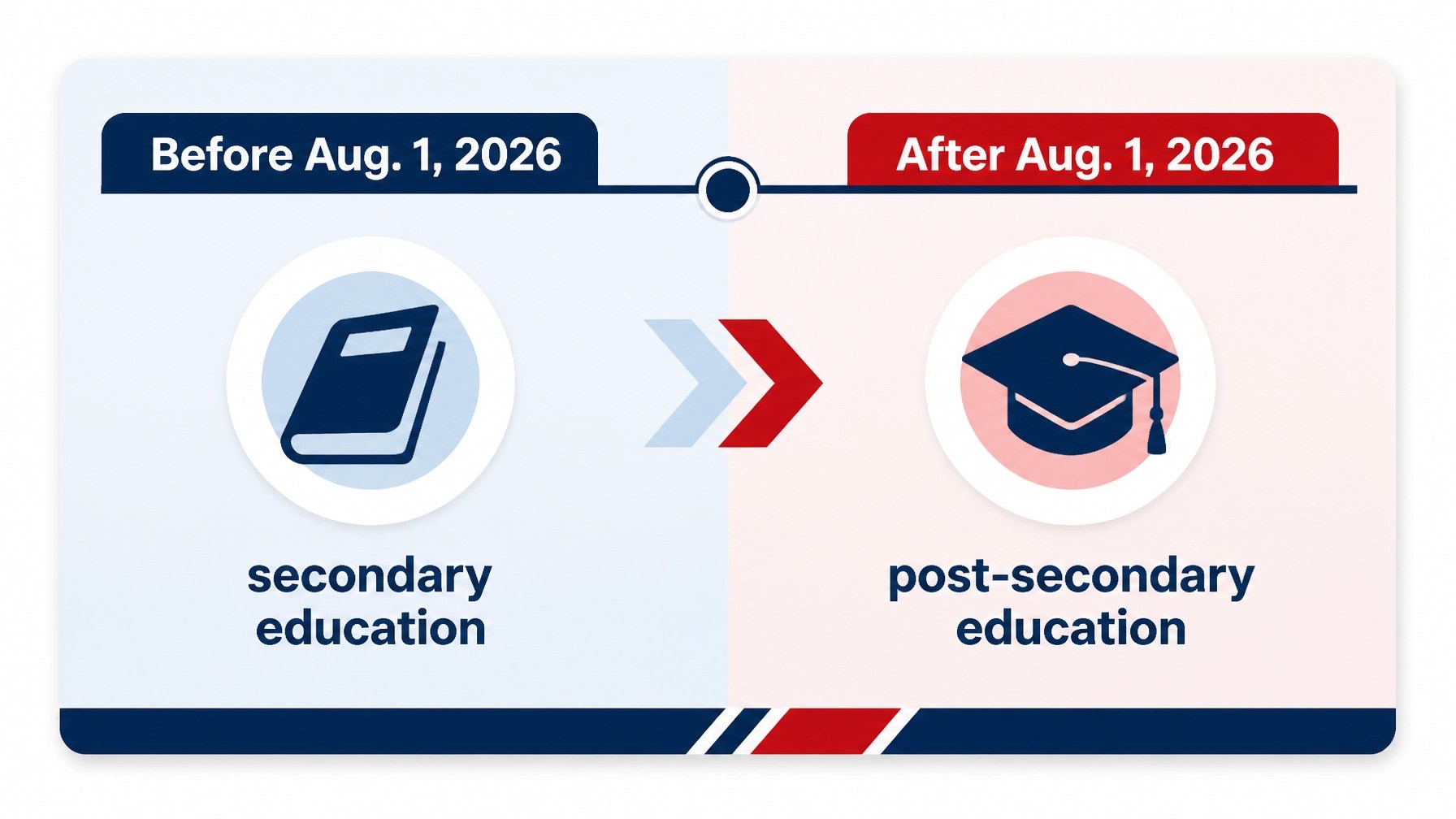
According to the VA’s official notice, the law changed the statutory definition of an “educational institution.” It replaced the term “secondary school” with “post-secondary school.”
In practical terms, Chapter 35 DEA can no longer be used for certain secondary-education activities when the program begins on or after August 1, 2026.
These activities may include:
- Certain high-school coursework.
- GED-level training.
- Tutoring.
- Academic remediation.
- Other approved secondary-level education activities affected by the statutory change.
This is a change in the scope of covered education. It is not the end of Chapter 35.
What Happens If a Student Already Started a Secondary Program?
The VA has provided a transition rule for students who began an eligible secondary-education program before August 1, 2026.
If the program began before that date, the student may continue receiving Chapter 35 DEA through the end of the current academic term.
The academic term could be a semester, quarter, trimester, or another period recognized by the school.
There is an important limit:
VA cannot continue paying Chapter 35 benefits for a subsequent secondary academic term, even if that additional term is needed for the student to graduate.
Families should not assume that existing payments will continue indefinitely. The program start date and the end of the current academic term matter.
Ask both the VA and the school’s certifying official to review your individual situation.
What Education Is Still Covered?
Chapter 35 remains available for eligible spouses and children who pursue qualifying post-secondary education and training.
Depending on eligibility and program approval, this may include:
- College and university programs.
- Certificate programs.
- Vocational or technical training.
- Non-college degree programs.
- Career training.
- Apprenticeships or on-the-job training.
- Licensing or certification preparation and testing.
- Other education and training programs approved by the VA.
The specific program must qualify under VA rules. A school’s general approval does not necessarily mean every program at that school is approved.
Before enrolling, use the VA’s GI Bill Comparison Tool and contact the school’s certifying official. That official can help confirm whether the specific program is approved for VA education benefits.
What Military Families Should Do Now
If your spouse or child receives Chapter 35 DEA, or you believe someone in your family may qualify, take these steps.
1. Confirm eligibility
Review the VA’s official Survivors’ and Dependents’ Educational Assistance page.
Check whether the veteran or service member meets an eligible condition. Then review the additional requirements for the spouse or child.
Do not rely on a general statement that someone is “a military dependent.” Eligibility depends on specific VA rules.
2. Identify the program level
Determine whether the student’s current or planned program is:
- Secondary education.
- Post-secondary education.
- Vocational or career training.
- Another type of approved education or training.
This distinction is especially important after August 1, 2026.
A program that prepares a student for future college work may still be classified as secondary education. Ask the VA or school certifying official instead of guessing.
3. Determine when the current term ends
If a student started an eligible secondary program before August 1, 2026, find out the exact end date of the current academic term.
Ask the school for this information in writing if possible. Then ask how the transition rule applies to the student’s remaining enrollment.
Remember that VA may continue benefits only through the end of that academic term. A later secondary term may not be payable.
4. Speak with the school certifying official
The school certifying official works with the VA to report eligible enrollment.
Ask this person:
- How is the program classified?
- When did the current term begin?
- When does it end?
- Is the next term considered secondary or post-secondary?
- Is the program approved for Chapter 35 DEA?
- What enrollment information must be submitted to VA?
Keep copies of enrollment records and communications.
5. Review post-secondary options
If secondary education is no longer covered for a future term, begin reviewing possible next steps.
Depending on the student’s goals, consider approved:
- College programs.
- Certificate programs.
- Trade schools.
- Vocational programs.
- Career-training programs.
- Apprenticeships.
- Licensing or certification pathways.
The change may require planning. Starting early gives the family more time to compare approved programs, application deadlines, enrollment requirements, and available financial resources.
6. Apply or review benefits through VA
Eligible dependents can apply using VA Form 22-5490, the Dependents’ Application for VA Education Benefits.
The form may be completed online or submitted as directed by the VA.
If you already applied, review the status of your claim and confirm that the VA has the correct school and program information.
For case-specific assistance, contact the VA through Ask VA or call 1-800-698-2411.
Do Not Rely on Old Advice
Benefits information can change.
Advice that was accurate when an older child attended school may not apply to a younger child. A social media post may leave out an important eligibility condition. A family friend may know what happened in one case but not understand how another case differs.
Before making enrollment or financial decisions, verify the details directly with:
- The VA.
- The school certifying official.
- An appropriately qualified or VA-accredited representative when additional assistance is needed.
A benefit unknown or misunderstood is a benefit at risk of going unused.
The Larger Lesson: Review Earned Benefits Regularly
Military families manage many programs at once. Education benefits are only one part of the larger system that may include healthcare, survivor benefits, disability compensation, home loan benefits, and state assistance.
Rules can change. Covered programs can change. Deadlines can matter.
Set a regular time to review the benefits available to your family. Revisit the information when a child approaches graduation, a spouse begins career training, or the family considers a major educational transition.
You do not need to understand every rule before asking a question. You only need to gather the basic facts and contact the right source.
A Tangible Act of Gratitude
At Operation T.A.G.: Tangible Act of Gratitude: we believe serving military families includes more than saying, “Thank you for your service.”
Sometimes a Tangible Act of Gratitude means helping a military family pursue homeownership. Sometimes it means helping an aging veteran understand available options. And sometimes it means sharing a timely update about an earned benefit before a rule change creates a financial surprise.
Operation T.A.G. does not administer Chapter 35 DEA and cannot determine eligibility. Our goal is to help military and veteran families find reliable information and take the next appropriate step.
Chapter 35 has not ended. The covered education has changed.
If your family may be affected, confirm your eligibility, identify the program level, check the term dates, speak with the school certifying official, and contact the VA directly. That is the clearest way to protect your family’s options.
Official Resources
- VA notice about the Chapter 35 secondary-education change
- VA Survivors’ and Dependents’ Educational Assistance page
- VA Form 22-5490
- Ask VA
- VA benefits contact center: 1-800-698-2411
Disclaimer: This article is for educational purposes only. It is not legal, financial, or VA benefits advice. Eligibility, covered programs, payment rates, entitlement, and transition treatment vary by individual circumstances. Confirm your situation directly with the VA and your school certifying official.
A Separate Free Homeownership Resource

The Mission Homeownership PDF e-book is a separate, free homeownership resource for active-duty service members, veterans, and surviving spouses. It is not a Chapter 35 application and is not a substitute for VA guidance. Scan the QR code to access it, or visit OperationTAG.org.
With gratitude,
Brett Stacy
National Director & Founder of the Hometown Hero Credit, a non-profit program of Operation T.A.G. (Tangible Act of Gratitude), and 501(c)(3) non-profit project of HDCF

Websites: www.OperationTAG.org and www.HometownHeroCredit.com
Phone: 760-456-8748 ( 24-hour Information Line)
Leave a Reply