
If you've been following our "Hidden Cost of Military Service" series, you know we've already talked about the housing stress that keeps military families up at night and the mental health battles that too many service members face in silence. Today, we're diving into maybe the hardest topic of all: family separation and how it ripples through every aspect of military life.
When people think about military service, they often picture the service member deploying overseas. But what they don't see is the spouse back home, juggling everything alone. They don't see the kids missing their parent at school plays, birthday parties, and bedtime stories. They don't see families trying to stay connected through grainy video calls across time zones, or the way relationships slowly strain under the weight of constant goodbyes.
The Numbers Tell a Story
Here's what the research shows us: time apart from family consistently ranks as the top stressor for military families. And it's not just about deployments anymore. A recent survey of nearly 11,000 service members, veterans, and their families found that separations have gotten even tougher with unexpected quarantine extensions, last-minute deployment changes, and the challenge of managing work and home life when everything feels uncertain.
This isn't just an active-duty problem either. National Guard and Reserve families face their own version of this challenge, often with even less predictability and support.
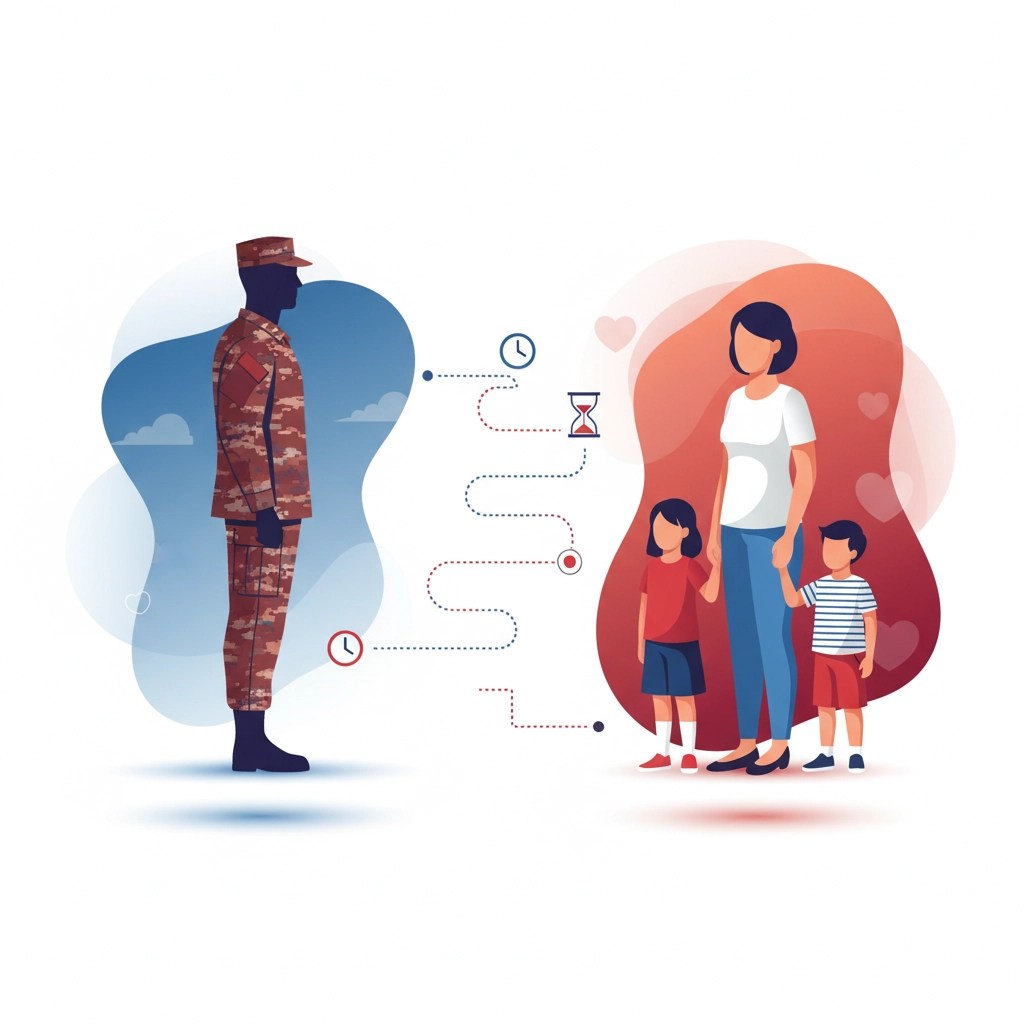
When Spouses Bear the Load
Let's talk about what happens to the spouse who stays behind. Since March 2020, 42% of active-duty spouses who were working before had to stop. Some got laid off or furloughed, but here's the kicker: 36% had to quit their jobs specifically to homeschool their kids or supervise virtual learning while their partner was away.
Think about that for a minute. These spouses didn't choose to leave the workforce. They were forced into it by circumstances beyond their control.
And then there's the PCS cycle. Every 2-3 years, military families pack up their lives and start over somewhere new. Each move means the spouse has to find a new job, often taking a step backward in their career. Research shows that a PCS move leads to a 14% drop in spousal earnings just in the year of the move. Imagine taking a 14% pay cut every few years, and you start to understand the financial pressure these families face.
For Guard and Reserve families, it's different but not easier. Nearly a quarter of Guard troops and a third of Reserve troops reported negative consequences with their civilian employers after deployments: lost promotions, missed training opportunities, or worse, losing their jobs entirely.
The Kids Pay the Price Too
Children of military families don't just miss their deployed parent: they carry the weight of that absence in ways that shape who they become. Research shows that the longer and more often a parent deploys, the higher the risk for psychological, health, and behavioral problems in their children.
Kids notice when their remaining parent is stressed, overwhelmed, or struggling to keep everything together. They see the empty chair at dinner, the missed games, the phone calls that end too soon. And when the deployed parent comes home, they're often dealing with their own invisible wounds that make it hard to reconnect.
The educational impact is huge too. Among military families, 78% of those with special needs kids lost educational services during COVID-related disruptions. Half of families who PCS'd during that time couldn't get their child's education plan transferred to the new school. Some families made the impossible choice to live separately just so their child could keep getting the help they needed.

Missing the Moments That Matter
Here's what the statistics can't capture: the birthdays celebrated over video chat, the first steps that only one parent sees, the school plays with an empty seat where dad or mom should be sitting. Military families become experts at celebrating holidays early or late, at explaining to teachers why their parent can't come to the conference, at saving up stories and achievements for when their service member comes home.
These missed moments add up. They create a kind of emotional debt that's hard to repay, no matter how many "I'm sorry I missed it" conversations happen later.
When Relationships Crack Under Pressure
The strain of repeated separations shows up in military divorce statistics. While the overall military divorce rate has improved in recent years, the numbers for younger military couples tell a different story. Spouses between 18 and 24 experience divorce rates as high as 50%: much higher than their civilian counterparts.
Most military divorces happen within the first five years of marriage, unlike civilian divorces that typically occur after ten or more years. The unpredictability of deployments, the stress of managing households alone, and the challenge of maintaining emotional connection across distance and time take their toll.
About 60% of military spouses report communication problems when one spouse is active duty and the other is civilian. Add PTSD, depression, or other combat-related mental health issues to the mix, and relationships face pressures that would challenge any couple.

The Financial Ripple Effect
We talked about housing costs in part one of this series, but family separation creates its own set of financial pressures. When a spouse can't work because of deployment or PCS moves, the family loses not just current income but also career progression, retirement contributions, and healthcare benefits.
Some military families end up maintaining two households: one where the service member is stationed and another where the family stays for school stability or spousal employment. The costs add up fast: duplicate rent or mortgage payments, travel expenses for visits, higher grocery and utility bills.
Emergency expenses hit harder when you're managing everything alone. When the car breaks down or a child gets sick and you're parenting solo, you can't split the responsibilities or the costs.
Finding Hope and Support
Despite all these challenges, military families are some of the most resilient people you'll ever meet. They've learned to adapt, to find strength in military communities, and to celebrate the moments they do have together with extra intensity.
Support systems make all the difference. Whether it's other military spouses who understand exactly what you're going through, family readiness groups that help during deployments, or programs that recognize the unique challenges military families face.
That's part of why we created the Hometown Hero Credit program: to provide real, tangible support when military families are ready to buy or refinance a home. Our 2% credit up to $21,000 isn't just about making homeownership more affordable (though it absolutely does that). It's about recognizing that military families face financial pressures that civilian families don't, and they deserve support that acknowledges those sacrifices.

Moving Forward Together
Family separation will always be part of military life. The mission comes first: we all understand that. But understanding doesn't make it easier for the spouse managing everything alone or the child who just wants their parent home for their birthday.
What we can do is recognize these hidden costs, support military families through the tough times, and remember that behind every service member is a family that serves too, in their own way.
The sacrifices military families make extend far beyond the service member's time in uniform. The missed moments, strained relationships, career setbacks, and emotional toll create ripple effects that last for years. As a grateful nation, we need to do more than say "thank you for your service": we need to provide meaningful support that helps these families not just survive but thrive.
Whether it's through programs that help military spouses find flexible employment, resources that support military children's education and emotional well-being, or financial benefits that ease the burden of homeownership, we all have a role to play in supporting the families who serve alongside our heroes in uniform.
Every military family's story is different, but the thread that connects them all is resilience, love, and an unwavering commitment to something bigger than themselves. They deserve our support, our understanding, and our action.
Brett Stacy
National Brand Ambassador / Founder
Hometown Hero Credit Program
Phone: 760-456-8748
Website: www.HometownHeroCredit.com
Blog: www.HometownHeroCredit.blog

Leave a Reply